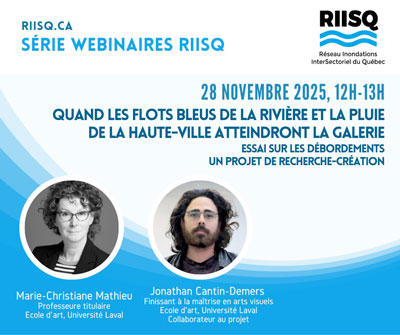
This webinar, hosted by the Réseau Inondations Intersectoriel du Québec (RIISQ), builds on research from the project Nous sommes tous des astronautes: scénarios et prototypes pour des temps extrêmes (NSTDA). Since 2021, co-investigator member Marie-Christiane Mathieu has been exploring issues related to flood zones, innovative materials, and printing processes for building emergency housing.
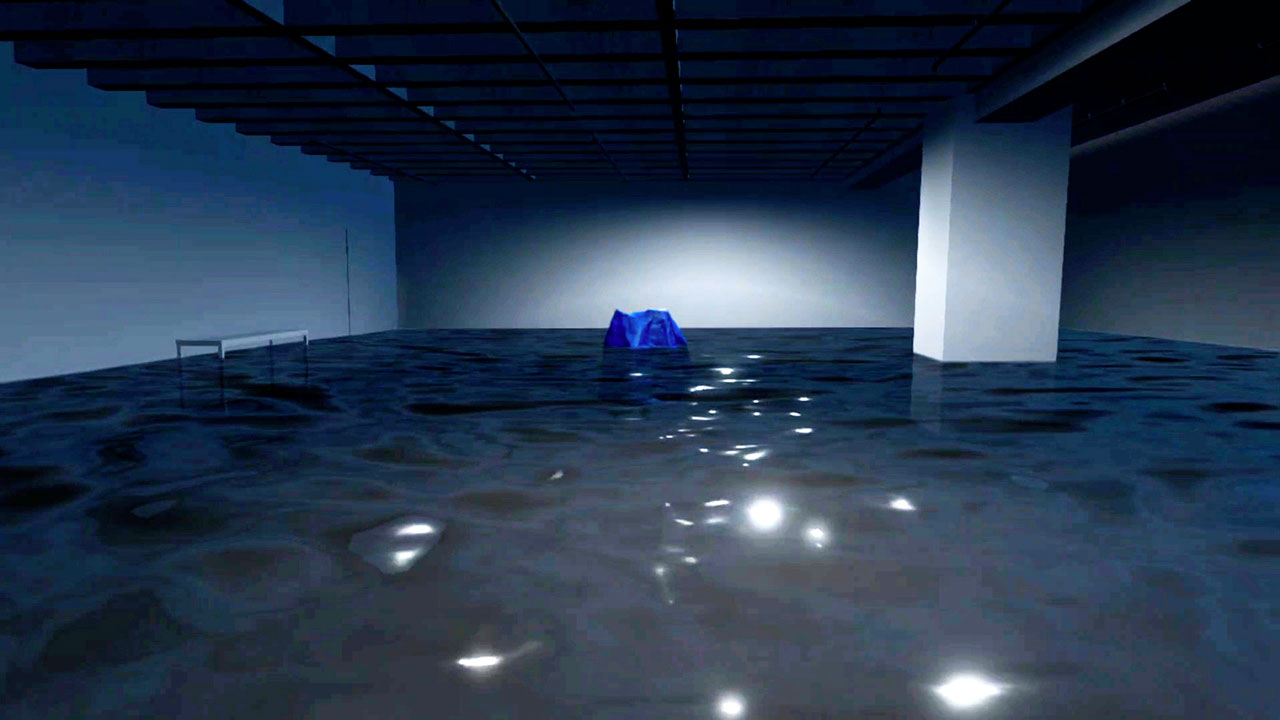
The talk focuses on the concept of the “digital shadow,” applied to the virtual reality work Quand les flots bleus de la rivière et la pluie de la haute ville atteindront la galerie. This research-creation by Marie-Christiane Mathieu—artist and professor at Université Laval—draws inspiration from flood zone challenges to fuel a creative research approach.
The “digital shadow” refers to the digital replica of an object, building, or system—in this case, the virtual simulation of a flood in an art gallery. This project extends the speculative approach of NSTDA, notably by building on the work of Université Laval’s Centre for Research in Geospatial Data and Intelligence (CRDIG).
To assess the real flood risks for the Gallery, the artist consulted scientific data, including flood zone maps produced by the Government of Québec, and spoke with two researchers from the Graduate School of Land Use Planning and Regional Development. According to these experts, the topography and recent developments significantly reduce the risks: the Galerie des arts visuels at Université Laval, located in the Saint-Roch district of Québec City, is safe from flooding until 2125. The project was supported by student members Jonathan Cantin-Demers and Vincent Isabel.
The Réseau Inondations Intersectoriel du Québec (RIISQ), funded by the Fonds de recherche duQuébec (FRQ), was created in January 2019. It serves as a platform for exchange and collaboration, bringing together government stakeholders, socio-economic partners, and research teams from social, scientific, technological, medical, economic, and political fields, to strengthen Québec’s ability to prepare for floods and reduce their impacts.
Cette publication est également disponible en :
Français (French)