In this DEMO, we present the innovative work of mechanical engineer Afsaneh Kheirani [student member, ÉTS], a graduate researcher at École de Technologie Supérieure (ÉTS) within the INIT Robots Laboratory, under the supervision of Prof. David St-Onge [member cochercheur, ÉTS] and Prof. Ilyass Tabiai. The innovation at the heart of her work—the design and fabrication of a robust yet ultra-light membrane—emerged not from industrial needs, but from the creative impetus and material constraints of Cavernautes, a research-creation project conceived by two Hexagram co-investigator members: Nicolas Reeves and David St-Onge.
In this context, artistic questions about sensory experience, delicacy, and adaptability guided the scientific inquiry, as the project required a membrane that would be flexible, translucent, and responsive enough to navigate confined, dynamic subterranean spaces. Through this active dialogue between art and engineering, her research advanced new approaches to polymer design, exploring how delicate films can remain flexible, repairable, and expressive under mechanical stress.
The resulting ultra-light membrane, now patented, has been integrated into Cavernautes—a subterranean aerial wanderer—where technology and artistic vision converge in practice.
As a mechanical engineer, Afsaneh Kheirani has devoted her career to the design and realization of lighter-than-air (LTA) systems, vehicles that ascend not only through thrust or aerodynamic lift, but also through buoyant equilibrium with the atmosphere. For more than seven years, she worked in the industry designing and manufacturing aerostat airships of varying sizes and mission profiles, ranging from large telecommunications platforms to smaller advertising and surveillance blimps operating close to the ground. Her role spanned mechanical and aerotactical design, load analysis, and manufacturing, translating conceptual sketches into functional aerial systems capable of extended autonomous flight.
The appeal of LTA systems has always been, for her, a balance between engineering precision and environmental elegance, flight sustained by helium buoyancy rather than power consumption. Such systems offer a quieter, energy-efficient alternative to heavier-than-air (HTA) craft, combining endurance, stability, and a minimal ecological footprint. This fascination eventually guided her toward academic research, where she could question and redesign the material and structural limits of LTA vehicles under new, highly constrained conditions.
Her work reveals how the discipline of mechanical design can open into a form of sensory exploration, where technical precision and spatial experience evolve together as part of the same creative process.
Development of the Ultra-Light Membrane
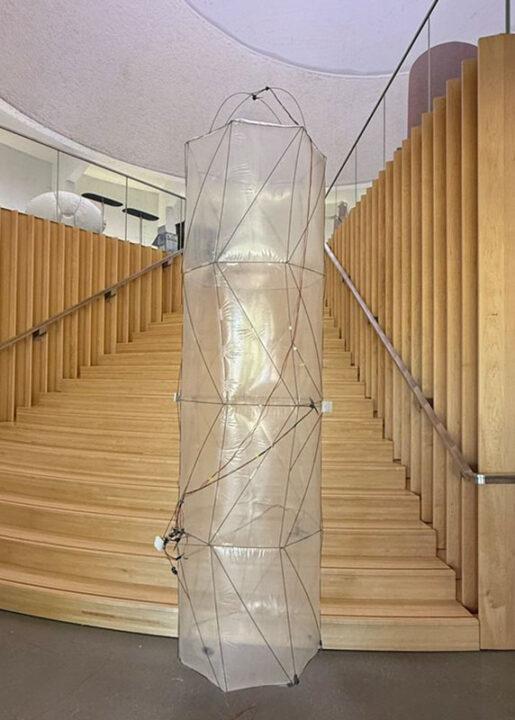
How to create an airship envelope that is ultra-light, airtight, and resilient enough to enable delicate autonomous flight in subterranean or industrial environments? Existing materials on the market or commercial films, such as polyurethane (PU) and Mylar, proved too stiff, too heavy, or too gas-permeable for such conditions. The challenge called for genuine material innovation. This pursuit led to the creation of a novel ultra-light polymer film membrane, developed under the project name VELUM (Vehicle Envelope with Lightweight Ultrafilm for Minimal Leakage) and now protected by a patent application filed by ÉTS. The objective was to maintain the flexibility and foldability of thin polymer film while significantly improving helium retention and surface durability.
To understand its behaviour, the material was examined through a complete series of laboratory experiments. Each test addressed a specific question about flight feasibility and revealed how its key behaviours differed from those of conventional materials:
How strong is it?
Tensile, puncture, and tear tests stretched different films until rupture, showing that the new polymer membrane deforms gradually and predictably before failure, whereas more conventional films tend to break suddenly.
How does it react to internal pressure?
Burst experiments inflated small prototypes until they exploded, mimicking the stresses experienced by a flying airship and confirming that the new film can tolerate high surface tension while remaining flexible.
Can it keep its gas?
Long-duration leakage tests compared helium loss through the different films and showed that the new membrane retains its volume significantly longer, indicating that the surface treatment effectively limits gas escape.
Can it survive handling and folding?
Durability tests reproduced repeated packaging, transport, and reinflation. While standard films often crease or stick to themselves under moisture, the new membrane recovered its form after multiple cycles.
How does its surface interact with water?
By observing how droplets sit on the surface, it became clear that the surface treatment encourages water to bead rather than spread, suggesting that the membrane can better resist humidity and condensation in damp environments such as caves.
Together, these observations revealed not only the mechanical strength but also the material personality of the new membrane: soft yet tough, transparent yet protective. It combines the lightness required for controlled indoor flight with the resilience necessary for repeated use.
Compared with traditional outdoor envelope materials, which are often thick, rigid, and over-engineered for indoor conditions, this new film offered a balanced compromise, easy to handle, quick to repair, and visually subtle when inflated.
Material and structure tests, ÉTS.
Cavernaute Artwork
Seeking to reveal to Montrealers the hidden treasure lying beneath their city for millennia, the two initiators—Nicolas Reeves, professor at UQAM’s School of Design, and David St-Onge, professor at ÉTS and a roboticist—imagined a unique immersive encounter. This project of research-creation invites art and scientific inquiry into a symbiotic dance.
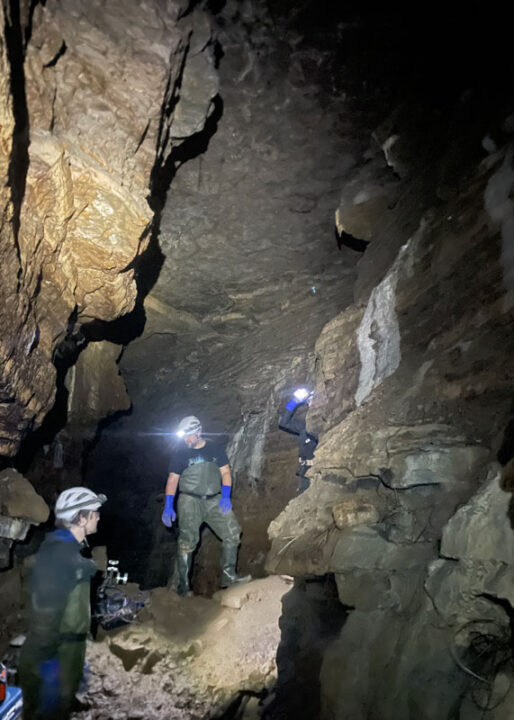
Explorations of the St-Léonard cavern.
Cavernautes is both an artistic and technological exploration of the Saint-Léonard Cavern, guided by a flying automaton from the family of aerostables—hybrid beings somewhere between drones and airships—designed to venture into spaces where human presence is nearly impossible. The experience intertwines the capture of ambient and underwater sounds through microphones and hydrophones with the diffusion of sonic sequences via semi-immersed speakers. The emitted sounds ripple across the surface of the water, their waves shaping the light projected onto the cavern walls into ever-shifting patterns—a visual resonance born of sound.
During the temporary exhibition, an immersive listening station composed of three large screens invites visitors to dive into this subterranean world. Audio and video data gathered beneath the earth are streamed live during moments of exploration, alternating with pre-recorded sequences—allowing audiences to witness, in real time or in reflection, the breathing heart of the cavern itself. While the technical team conducted flight operations underground, Prof. Nicolas Reeves’s group at NXI GESTATIO simultaneously presented an immersive installation that transmitted live video and ambient audio from inside the cave to an audience space. This connection between real-time exploration and mediated experience exemplified the collaborative nature of research-creation: engineering data and artistic perception emerging in parallel.
Exhibition view.
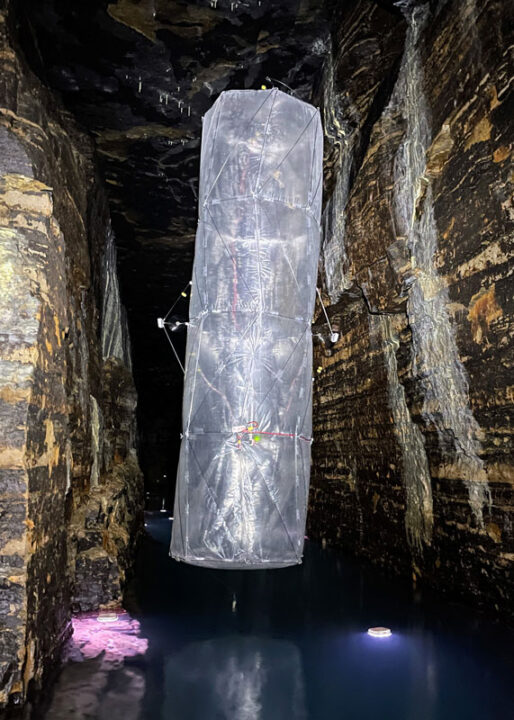
Following extensive laboratory validation, the newly developed membrane was integrated into a functional airship prototype for Cavernautes. It was deployed in Montréal’s Saint-Léonard Cave on 16 August 2024, where its soft, translucent envelope reacted to air currents, humidity, and pressure with subtle pulsations. Inside this environment, engineering function and aesthetic perception merge: structural resilience becomes a visible rhythm, and the physics of buoyancy takes on the quiet cadence of breath.
Application at the cave.
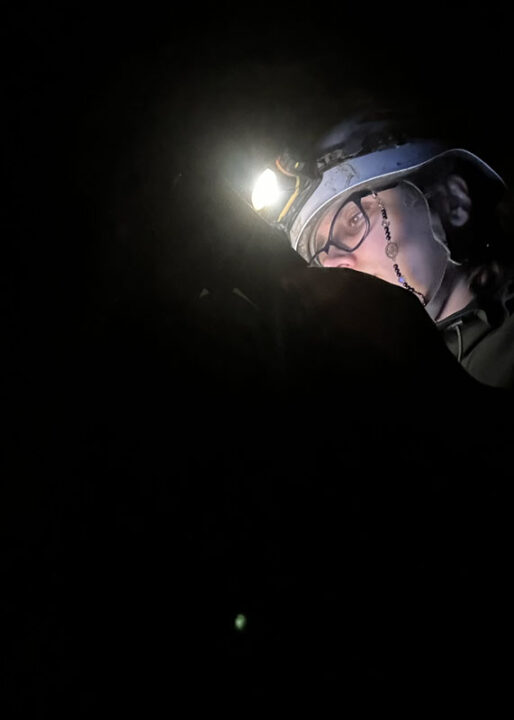
The mission illustrated not only the material’s technical success but also its aesthetic and experiential dimensions. Under headlamps and the cave’s faint reflections, the semi-transparent film revealed layers of wrinkling and pulsation as internal pressure fluctuated with temperature and motion. These living, breathing patterns visually echoed the physical processes of the cave itself, air, humidity, and time, turning the engineering experiment into a sensory encounter.
Application of the ultra-light membrane at St-Leonard’s Cave.
Significance
This work demonstrates that the boundaries between technical validation and artistic exploration are porous. The iterative testing that quantifies stress, pressure, and leakage also reveals visual and tactile phenomena, fragility, transparency, and resilience that can be experienced as part of a broader creative vocabulary. In the laboratory, the rupture of a film becomes a visible event; in the field, the same thin surface becomes an interface between air, light, and the subterranean environment.
The VELUM membrane thus serves a dual purpose: it fulfills the engineering demand for a lightweight, low-permeability envelope, and it materializes a poetic relationship between structure and breath. Its design and testing contribute to ongoing research in polymer engineering, while its deployment within Cavernautes positions it within the lineage of research-creation practices that unite science, art, and technology through shared material inquiry.
Beyond cave exploration, this membrane technology opens pathways toward new kinds of indoor aerial systems for inspection, documentation, and human-robot interaction, where minimal energy, low noise, and soft contact are essential. It represents a concrete step toward sustainable, context-aware flight, an achievement rooted in empirical mechanics but open to artistic interpretation.
For Afsaneh Keirani, the appeal of LTA systems has always been, a balance between engineering precision and environmental elegance, flight sustained by helium buoyancy rather than power consumption. Such systems offer a quieter, energy-efficient alternative to heavier-than-air (HTA) craft, combining endurance, stability, and a minimal ecological footprint. This fascination eventually guided her toward academic research, where she could question and redesign the material and structural limits of LTA vehicles under new, highly constrained conditions.
Her work reveals how the discipline of mechanical design can open into a form of sensory exploration, where technical precision and spatial experience evolve together as part of the same creative process.
Acknowledgements
This project was carried out within the INIT Robots Laboratory at École de Technologie Supérieure (ÉTS), under the supervision of Prof. David St-Onge and Prof. Ilyass Tabiai (LIPEC Lab). It was supported by the Fonds de recherche du Québec—Nature et technologies (FRQNT, Team Grant #283381) and developed in collaboration with NXI GESTATIO Laboratory (Prof. Nicolas Reeves) at UQAM, as part of a research-creation initiative in the arts. The author also acknowledges the Cavernautes research group.