In this DEMO, we present the creative work, methodology, and main research questions undertaken by PULSE, a collective of Concordia based researchers, performers, designers, artists, educators, and graduate students during research-creation activities at Concordia University.
In 2025 PULSE began to host weekly research-creation activities focused on the theme of radical hospitality. The collective, led by professor, artist, and researcher Shauna Janssen, met on Wednesday afternoons between January and June.
The research activities are built on Janssen’s ongoing project,this space is for you. This project aims to offer a platform for centring queer phenomenology, pluriversal scenographic design practices, and feminist technoscience studies as embodied methodologies for creating with technologies of capture. It explores the capacity that immersive environments have to reveal and stage the atmospherics of hospitality.
this space is for you 2.0investigates the concept of radical hospitality in embodied and experiential ways using technologies of capture, guided by key research questions such as:
How can extended reality (XR) environments be experienced as hospitable spaces?
What can embodied and somatic engagements with technologies of capture teach us about staging inclusive and pluralistic environments?
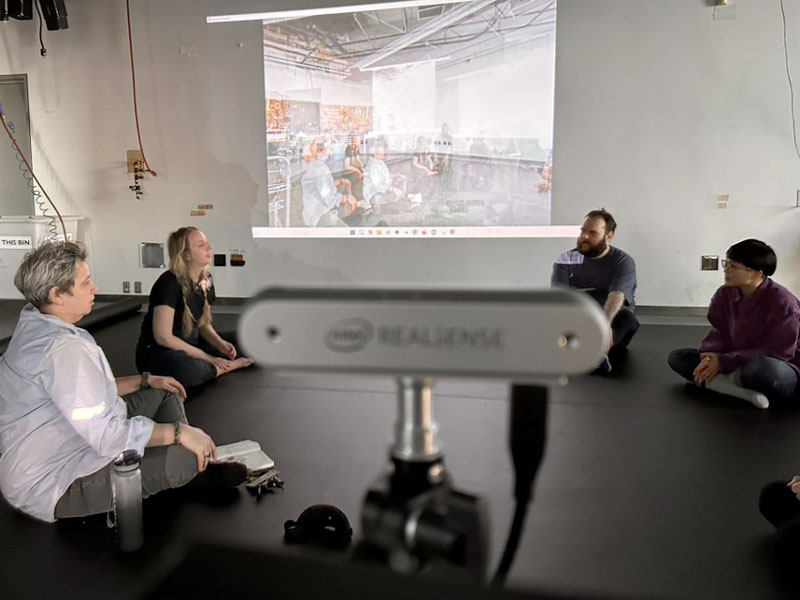
Weekly winter workshop sessions became ritual. The collective gathered around a large oval table to check in, which opened up trust for mutual sharing about what spoke to each of the collective members about the theme of welcoming and feelings of hospitality. The collective exchanged gifts—objects, texts, stories, food—and other offerings at most weekly sessions. Their collective activities also involved creating movement scores emerging from somatic explorations, led by Gabi Petrov.
Somatic Improvisation and Digital Feedback
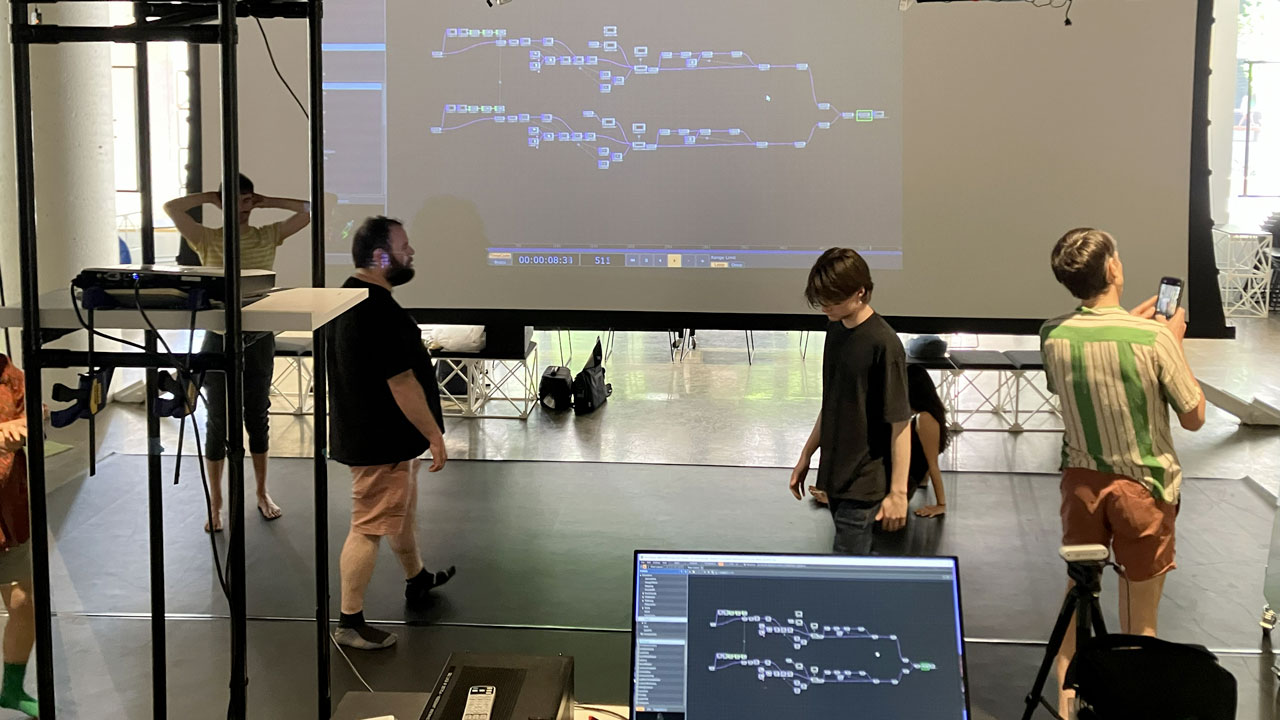
The somatic improvisations and scoring sessions were captured with TouchDesigner (TD) software and Intel RealSense sensors to capture the performers’ movements.
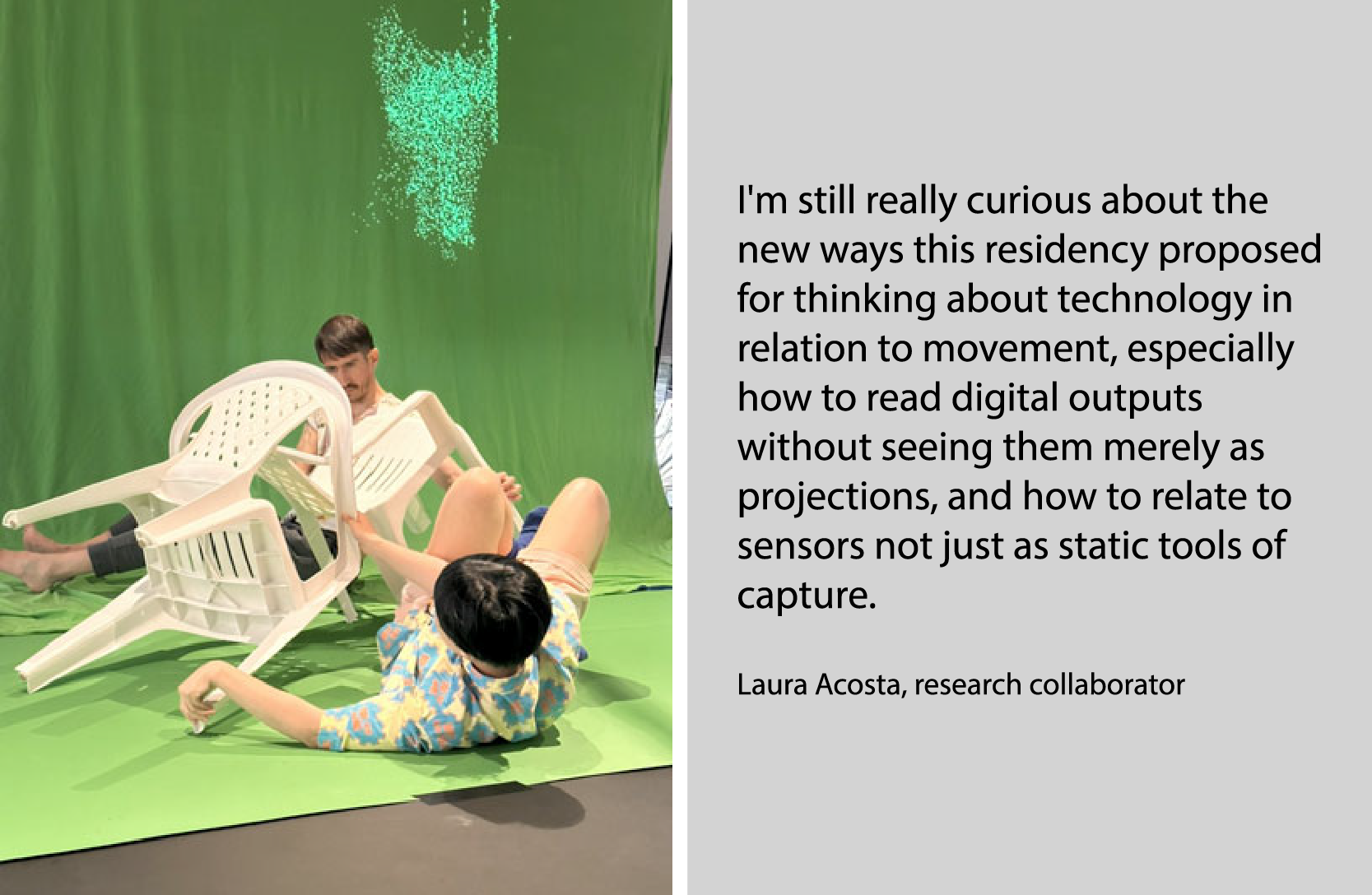
Initial experiments with the technology allowed performers to sense their own agency and relationship to the sensors, to understand how their movements and decisions in the space could interact. Throughout the scoring, the performers were able to witness their digital selves; transformed into particles and textures projected on a wall. These scoring sessions aimed to move beyond the conventional view of technology as merely a means to an end, embracing instead the potential performative qualities that capture technologies can harness; creating new forms of engagement and relationality.
Using a green stage, performers’ movements and gestures were captured as they responded to scores through TD. These recordings were then processed through a particle system that transformed bodies into abstract, moving visual forms. Projected back onto the stage, these visuals invited performers to re-engage with the traces of their previous actions while performing new scores, creating a continuous interplay between body, image, and technology. The digital-physical feedback loop became central to dramaturgical considerations in the development of the project. The interplay between technology and performers required their co-presence within a spatial environment composed of sensors, projection systems, computer screens and towers, cables and scenographic elements such as a chair, a dance floor, a green floor and backdrop. In this environment, performers, space, and technology were not distinct entities but mutually affecting agents, each shaping the evolving dynamics of the work.
In Residency: Creating and Inhabiting a Space
Residency activities included the creation of a series of performance scores, emerging from somatic explorations that brought forth, to use Esteban Donoso’s words, “questions of time, repetition, echoes and traces, and the mutual affectation of bodies and spaces—challenging the real virtual dichotomy of performing with technologies of capture, and addressing the complexities in between. These scores, derived largely from somatic work, invited participants to consider how to create and inhabit a familiar—unfamiliar, always-elusive space in ways that welcome the plural, the queer, and the unexpected.”
Working with TD in the residency involved orchestrating video capture, digital processing, and projection on stage in close collaboration with the collective. Performers were introduced to technological needs to capture their body shapes and movements, making them aware of key spatial parameters.
In this set-up, explorations were recorded from front and top view sensors yet the green stage area that defined the capture zone did not cover the entire stage. By recognizing and adapting to these spatial and technical constraints, performers engaged with them creatively and playfully, deepening their awareness of the technology’s presence and agency within the performance space.
In this scenario, TouchDesigner was not merely a tool. Through operating the system, the technology both affected and supported the performers’ movements during the recording process—starting, pausing, and stopping in response to their gestures—without constraining them, allowing space for improvisation and spontaneity.
Dramaturgy with TouchDesigner
A dramaturgical approach to working with TD helped to focus on shaping sequences of interconnected nodes and involved transforming captured videos into abstract particles of moving bodies through the particle GPU operator. This workflow embraced openness and imperfection, treating flaws as part of the creative and experimental process.
The intent of transforming captured movements was not to create perfect visual replicas of moving bodies, but rather to explore from somatic explorations a sense of presence—or co-presence—through echoes, repetitions, and traces. Working with the TouchDesigner interface meant modifying particle colours and their behaviour, scale, quantity, density, opacity, and playing with delay, motion dynamics, and texture renderings.
These dramaturgical considerations produced glitches, distortions, and uncanny effects, further enriching the feedback loop between live performance scoring and technological mediation. The performers’ movements and gestures were tracked by Intel RealSense sensors and applied to Particle GPU via TD Optical Flow, allowing real-time interaction between the performers with the captured and transformed video projections. By focusing on how the technology feels rather than how it functions, the experience became a sensory one—marked by vulnerability and uncertainty.
As Janssen explains, “this space is for you 2.0 is both a conceptual place and an emergent performance space from which to collectively stage gestures of hospitality and to underscore the political work of deviating from the sociocultural norms that predominantly drive the pervasiveness of ‘’’world-building’ immersive environments with XR technologies.” The project engages with notions of digital tenderness (Axelsson, 2024) as a dramaturgical consideration for staging environments of hospitality, and tenderness as methodology for undertaking embodied and collective experiments with technologies of capture.
—Text by Kévin Pinvidic, Student member, Concordia University
Shauna Janssen, PhD, is PULSE Creative Director and Principal Researcher. She is Associate Dean of Academic Programs & Pedagogy, Faculty of Fine Arts, Concordia University, where she also is director of the immersive storytelling studio at Milieux Institute for Arts, Culture & Technology and a co-investigator with Hexagram.
Multidisciplinary artist Kévin Pinvidic is currently a PhD candidate at Concordia University (INDI program) and holds a SSHRC scholarship. His doctoral research creation project focuses on the multiple crossroads between scenography, urban studies, geography, and computation arts, and draws from performative and collaborative methods for engaging citizens in processes of urban change. Pinvidic trained in design and architecture (Ecole Boulle, Paris, 2008, National School of Architecture of Versailles, 2010) and holds a Master of Fine Arts from UQÀM (2015). He is also an active scenographer and designs for live performances with several theatre and dance companies in Montréal.
Credits for this space is for you: exploring the atmospherics of hospitality.
Creative Director
Shauna Janssen
Research-creation team
Laura Acosta
JoDee Allen
Esteban Donoso
Steven Greenwood
Syd Hosseini
Peng Hsu
Gabriela Petrov
Kévin Pinvidic
TouchDesigner software screenshots
Kévin Pinvidic
Video Trailer
Kévin Pinvidic (digital content)
Syd Hamidreza Hosseini (editing)
The research is funded by the Hexagram Network Matching and Seeding Funds Program (2024), Milieux Institute for Art, Culture & Technology, Concordia’s office of the Vice Provost, Research, Innovation & Impact and Hemispheric Encounters (SSHRC PG).