In this DEMO, we present Growing Affinity, a project that explores how gender-affirming healthcare systems shape transfeminine bodies. Through semi-living sculptures that decay and transform over time, the work materializes transgender embodiment while creating alternative frameworks for understanding resistance beyond clinical narratives.
Developed as Jacqueline Beaumont’s MA thesis-creation at Concordia University, Growing Affinity was exhibited at the Canadian Cultural Centre in Paris as part of “Oscillation,” from October 16, 2025, to January 16, 2026, and presented in Montreal at Espace Transmission as part of “Panacea,” from February 4 to 9, 2026.
Artistic Approach
Growing Affinity employs what I term an “Affective Metabolic Pathway” (AMP), a framework describing how bodies metabolize toxic conditions into something generative rather than simply enduring them. Just as cells process nutrients and waste, this research-creation “digests” lived experiences through materials, transforming violence into vitality. The work emerges from three research phases: Biomaterial Design and Engineering, Exhibition Knowledge Production, and Community Dialogue. This integrates empirical research with biodesign practice, generating material and theoretical knowledge through the synthesis of art and social analysis.
I deliberately appropriate anatomical simulation tools, ballistic gelatin dolls, Fleshlights, dissection artifacts, objects culturally positioned to simulate feminine bodies. By appropriating these forms, I examine how transgender bodies become embedded within networks of commodified objects. My choice to work with slaughterhouse-byproducts, extracting gelatin from commodified remains, draws connections between how both transgender individuals and animals become sites of extraction within industrial capitalism.
Theoretical Framework
The work is grounded in a broad spectrum of trans feminist thought and new-materialist theory, drawing on Mel Y. Chen’s “Animacies,” Jane Bennett’s “Vibrant Matter,” Stacy Alaimo’s concept of “Trans-corporeality,” Eva Hayward’s “Trans*animalities,” Susan Stryker’s “Trans-monstrosity,” and Carol Adams’ “Absent Referent.” Rather than designing against vulnerable bodies, I design from them, treating vulnerability as an evolutionary strategy rather than failure. This connects necropolitical analysis to material practice, examining how objects condition cognition and shape embodiment and relationality.
The Process
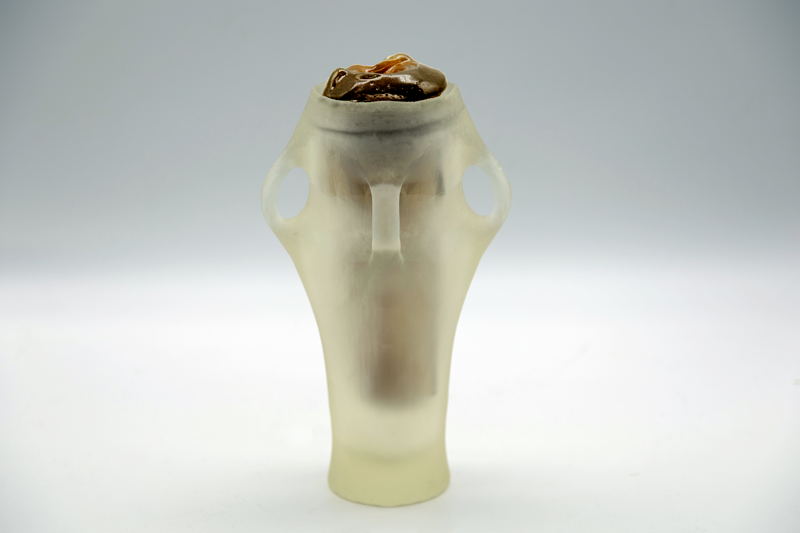
The sculptures begin with a 3D-printed scaffold structure, these TPU scaffolds are repeatedly encased in a biopolymer hydrogel formulation derived from slaughterhouse by-products, sourced from the Montreal area. Translucent layers accumulate through multiple dipping cycles and vegetable tanning treatments, leave a soft, flesh-like layer which refracts light through the interiors.
I embed intimate materials within the gel: human hair, pearls, acrylic nails, sequins, depilatory wax, and estradiol valerate. These reference transgender bodily modifications and beauty practices, creating hybrid artifacts navigating between violence and seduction, care and consumption, the clinical and the sensual.
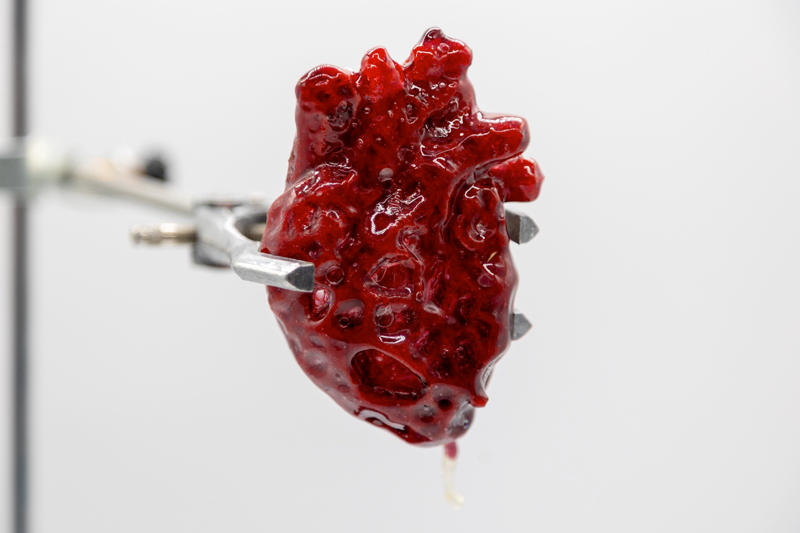
The gelatin formulations involve precise crosslinking systems using natural tannins and salts, developed through craft-based methods at the Milieux Speculative Life Biolab. The material accepts vulnerability as inherent. Throughout their exhibition, these semi-living objects undergo metamorphosis, desiccating, contracting, cracking, developing microbial communities. This decay transforms static objects into durational performances echoing the incremental nature of transition itself.
The sculptures materialize four survival strategies identified through community research. Stealth renders through layers of translucent gelatin that simultaneously reveal and conceal, mirroring how trans individuals strategically negotiate visibility within society. Glamour materializes through embedded beauty objects, pearls, sequins, acrylic nails, recognizing the laborious maintenance of beauty as survival work while examining how class and race intersect with these beauty standards.
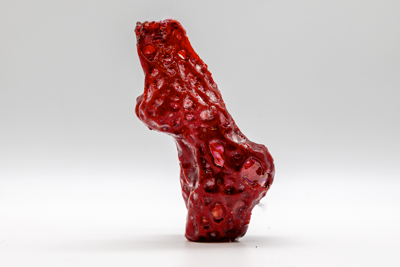
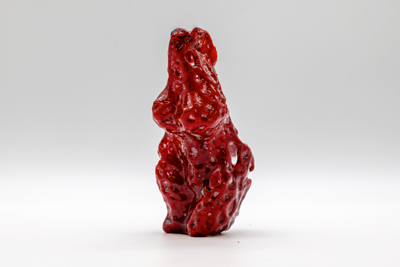
Monstrosity embodies in hybrid organic/synthetic forms refusing palatability, sliding between technological precision and organic instability, the familiar and alien, beautiful and grotesque. Care manifests through collaboration with microbial communities and acceptance of decay, suggesting alternatives to institutional frameworks and echoing the mutual aid networks, chosen family structures, and peer education sustaining trans communities when formal healthcare fails.
The Works
The “Dolls” inhabit thresholds between organic and technological domains, positioned on metal pedestals as both subjects of examination and scientific curiosity. Their morphology references “ballistic gelatin” models from wound pathology studies, commercial sexual artifacts like the masturbatory sleeve, rendering visible the overlap between medical violence and sexualized violence.
The “Fleshlight” reconceptualize recognizable sex toy forms, exposing how feminized bodies are positioned as consumable, discreet objects. By scaling up these intimate devices and rendering them in biomimetic, flesh-like materials, I foreground the extractive logic embedded in objects designed to simulate bodies without subjectivity or consent.
The “Organ Forms” blur boundaries between simulation and reality, referencing medical technology and the clinical gaze. Their inevitable decay resists the fantasy of preservation, insisting on the body’s refusal to remain stable or controllable. Like Frankenstein’s creature, these sculptures combine technological precision with organic unpredictability, manifesting as vessels of perverse yearning. Simultaneously crafted with intention yet surrendered to biological processes beyond man’s control. They function as reflection generators, compelling viewers to confront simulated bodies, gendered violence, and the commodification of transgender experience.
Growing Affinity contributes to transgender studies, bioart, and new materialism while advocating for expansive approaches to healthcare and embodiment. The AMP framework offers an alternative methodology treating the studio as a research site where materials actively assist in generating understanding. By adapting biodesign, into craft-based methods the work demonstrates how we can democratize knowledge while creating sensitive dialogue with biomedical systems.
Through speculative and semi-living biodesign, Growing Affinity offers new ways of seeing, feeling, and understanding transfeminine embodiment, ways that refuse containment, metabolize violence into vitality, and invite viewers to reckon with the porous, unstable, beautiful reality of becoming.
Adams, C. J. (2010). The sexual politics of meat: A feminist-vegetarian critical theory. Continuum. (Original work published 1990)
Alaimo, S. (2010). Bodily natures: Science, environment, and the material self. Indiana University Press.
Bennett, J. (2010). Vibrant matter: A political ecology of things. Duke University Press.
Chen, M. Y. (2012). Animacies: Biopolitics, racial mattering, and queer affect. Duke University Press.
Fackler, M. L., & Malinowski, J. A. (1988). Ordnance gelatin for ballistic studies: Detrimental effect of excess heat used in gelatin preparation. American Journal of Forensic Medicine and Pathology, 9(3), 218–219. https://doi.org/10.1097/00000433-198809000-00008
Hayward, E., & Weinstein, J. (2015). Introduction: Tranimalities in the age of trans* life. TSQ: Transgender Studies Quarterly, 2(2), 195–208. https://doi.org/10.1215/23289252-2867446
Stryker, S. (1994). My words to Victor Frankenstein above the village of Chamounix: Performing transgender rage. GLQ: A Journal of Lesbian and Gay Studies, 1(3), 237– 254. https://doi.org/10.1215/10642684-1-3-237
Images : Jacqueline Beaumont
Jacqueline Beaumont is a designer, artist, and researcher working at the intersections of biotechnology, sexuality, nature studies, and material culture. Based in Tiohtià:ke/Montréal, she is affiliated with the Milieux Institute, Concordia University Research Chair in Critical Practices in Materials and Materiality, and McGill University’s Biointerface Lab. Her work has gained recognition at venues including Centre Pompidou, Mutek, MIT, and Pangée. She is completing her MA thesis-creation at Concordia University supervised by Dr. Alice Jarry (Design and Computation Arts), Dr. Krista Lynes (Communications), and Aaron McIntosh (Fine Arts).
Acknowledgements
I wish to thank my supervisors Dr. Alice Jarry, Dr. Krista Lynes, and Aaron McIntosh for their guidance throughout this research. I extend my profound gratitude to the Centre for Gender Advocacy, Espace Transmission, and Concordia’s Core Technical Centre Staff. (Léah BG, Jules BD, Joé C-R, Brian C). This work was supported by the Social Sciences and Humanities Research Council of Canada, Concordia University Research Chair in Critical Practices in Materials and Materiality, the Milieux Institute, Speculative Life BioLab (Alex Bachmayer), the Feminist Media Studio, and the Queering Nature Studies Research Group. Additional thanks to the Hexagram Network team for their support in documenting this research-creation project.