In this DEMO, we present the research and creative methods behind the exhibition Quand les flots bleus de la rivière et la pluie de la haute-ville atteindront la galerie : Essai sur les débordements.
This exhibition was produced as part of the research project Nous sommes tous des astronautes : Scénarios et prototypes pour des temps extrêmes (NSTDA). The development team is a collaboration between professor, artist, and co-investigator member Marie‑Christiane Mathieu, and graduate student members from the School of Arts at Université Laval: Jonathan Cantin‑Demers and Vincent Isabel.
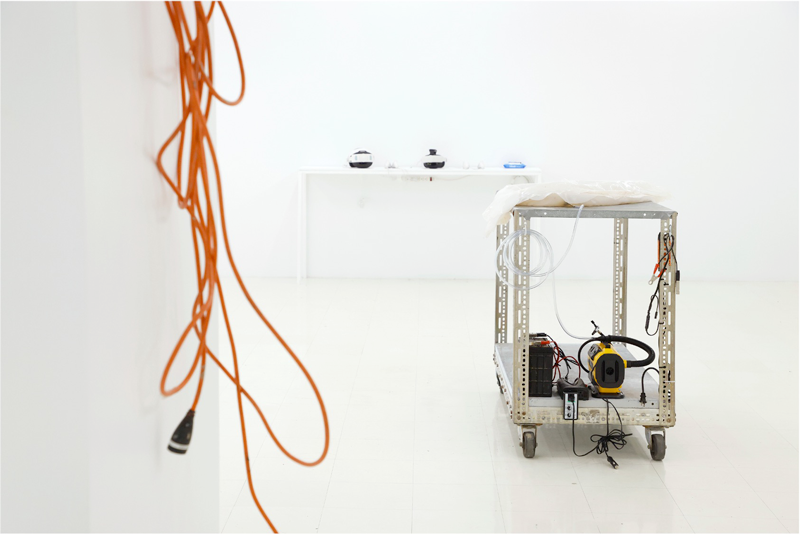
Presented from April 17 to May 25, 2025, at the Galerie des arts visuels of Université Laval, the exhibition takes the form of an installation consisting of a sculpture, photographs, and a virtual reality experience developed specifically for the gallery space.
Sculpture and installation in the gallery, 2025. ⒸMarie-Christiane Mathieu
Nous sommes tous des astronautes — Context and Research Questions
The beginnings of the project follow the NSTDA methodology. Launched in 2021, the research project brings together researchers and students from undergraduate to doctoral levels at the School of Arts and the School of Architecture at Université Laval. NSTDA responds to recommendations from the 2018 report The next generation of emerging global challenges: a Horizons 2030 perspective on research opportunities, commissioned by the Social Sciences and Humanities Research Council of Canada (SSHRC).
Among the proposed objectives, the following were retained:
Rethinking creative practice through speculative projections.
Going into the field and/or recreating difficult environments to test survival habitats (capsules).
Solving material and technological challenges through interdisciplinarity.
Assessing issues related to climate change, particularly flooding and rising water levels.
In 2021, Marie‑Christiane Mathieu, aboard her own survival habitat—a 2011 Mercedes Sprinter—travelled to Lafayette, Louisiana, to witness firsthand the extent of damage caused by Hurricane Ida (August 2021).
Trip to Louisiana, 2021. ⒸMarie-Christiane Mathieu
This is where the inspiration for the exhibition project emerged: from field experience that led to reflections and speculations on the territorial fragility of Quebec City, specifically the flood risks of its lower town.
Statistics and Flood Studies
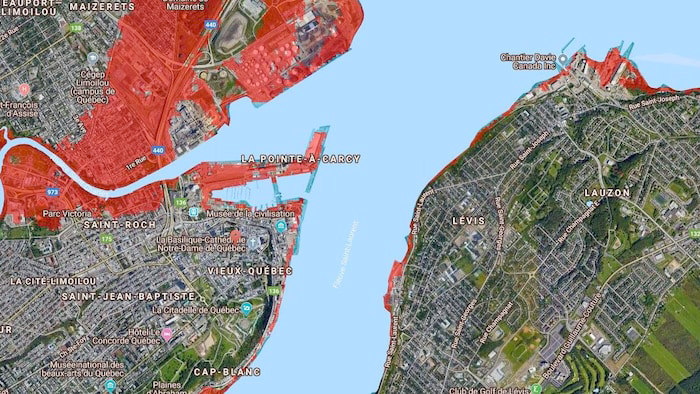
To develop the hypothetical flooding of the gallery, we relied on the interactive flood‑risk maps of Quebec. In the spirit of our research, using speculative methodologies, we gathered all factors that could accelerate flooding within the university gallery.
Flood‑Risk Zones in 2030. Source: Climate Central, 2021
Topography of Quebec City. Source: topographic-map.com, 2021
The main considerations enabling flooding are climatic and meteorological. First, due to global pollution, the estimated increase in average temperature contributes to sea‑level rise. Second, precipitation patterns are changing: results show an overall increase in rainfall intensity, which is relevant for our speculative scenario.
The gallery’s physical situation adds to these factors: it is located in a semi‑basement of the Fabrique building, making it prone to flooding. A large parking lot separates the building from access to the upper town, suggesting the possibility of runoff flowing toward it. In our speculative scenario, we also imagine ruptures in heating or water circulation pipes inside the gallery.
Considering the rising water levels and increased rainfall, together with the gallery’s physical context—especially its proximity to the Saint‑Charles River—we established our flooding scenario.
Digital Shadow—Virtual and Physical Realities
The experience was designed based on a 3D model aligned precisely with the gallery’s physical structure. This space between physical and digital realms creates an interplay that echoes the concept of the “digital shadow.”
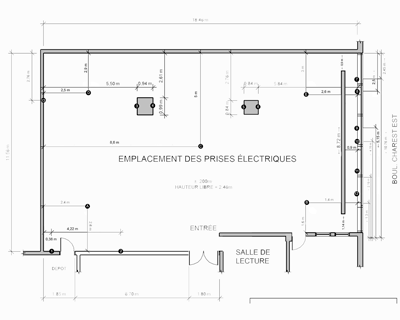
After modelling the gallery, we identified four possible water entry points: the main door, the facade windows, the ceiling sprinkler pipes, and a drain located in the back storage room. The VR flooding scenario follows these same entry points to maintain plausibility.
3D Model of the Gallery, 2025. ⒸJonathan Cantin-Demers
Architectural Plan of the Gallery, 2025. Source : Université Laval
The virtual reality experience was developed by Vincent Isabel and Jonathan Catin‑Demers. We used the Unity game engine and the 3D modelling software Blender.
Video capture of the VR experience, 2025.ⒸJonathan Cantin-Demers
Agency Between Object, Shadow, and Aura
In our speculative scenario, the “shadow” of our physical object (the gallery) becomes the virtual flood. Adjacent to this concept is the “digital twin,” referring to the agency that exists between a physical object and its digital shadow.
A study day was held on February 14, 2025, gathering professors, researchers, and students. The goal was to exchange ideas about these concepts, assessing the degree of mismatch between real and virtual spaces and exploring the experiences that arise from these tensions.
Four notions were retained for our project:
The object: the gallery.
The shadow: the virtual flood.
The aura: the sensations, memories, and images emerging from an artwork.
Agency: the relationships and affects between all of the above.
Video excerpt from the opening, 2025. ⒸMarie-Christiane Mathieu.
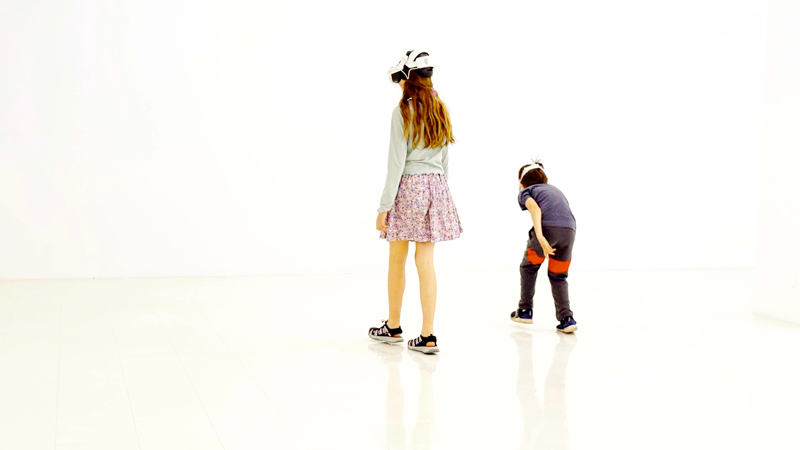
The agency of the digital shadow manifests in the experience of the space between objects and virtual, between sight and touch. It arises from this delicate distance that affects us—where the entanglements between object‑shadow‑aura converge into a total experience, one that ultimately depends on individual sensitivities, memories, and knowledge.
Photograph during the opening, 2025. ⒸMarie-Christiane Mathieu.
Marie-Christiane Mathieu is an artist and full professor at the École d’art of Université Laval. Her research explores hostile environments and the forms of life they generate. She seeks to define an aesthetics of transit and develops artistic methods aimed at constructing critical objects functioning as forms of foresight influencing other disciplines.
Collaborators
Vincent Isabel is a tinkerer, sound artist, and performer based in Quebec City, on the ancestral territories of the Wendat, Innu, and Abenaki peoples. His practice explores dynamics between his body, his intimacy, and the technological materials around him. Seeking to create sonic instruments and systems that challenges mastery, he provokes and navigates through loss of control as a performance frame.
Graduate of a BFA from Emily Carr University in 2024, Vincent is currently pursuing a master’s degree in visual arts at Université Laval and collaborating with Avatar as part of the artist centre master’s residency.
Jonathan Cantin-Demers lives and works in Quebec City as a professional artist. He holds a graduate diploma in visual arts (2026) from the École d’art at Université Laval. His work has been presented at the Galerie des arts visuels, notably in the exhibitions Banc d’essai (2022) and Traverser l’immédiat (2025), as well as during Mars de la maîtrise (2024, 2025). Since 2024, he has collaborated on various public art projects as part of EXMURO’s technical team and has held research assistant positions on several artistic and research projects. Since 2025, he has served on the boards of the artist run centre Avatar and the ForCGal Foundation.
Acknowledgement
Marie‑Christiane Mathieu wishes to thank Andréane Sicotte from the Virtual Reality Laboratory at the Jean‑Charles‑Bonenfant Pavilion Library of Université Laval, La Bande Vidéo, graduate‑student researchers Jonathan Cantin‑Demers and Vincent Isabel, as well as Geneviève Chevalier, professor at the School of Arts, the School of Design, and the School of Architecture for the equipment loan, along with the Visibility Support Program of the Faculty of Planning, Architecture, Art and Design (FAAAD). Thanks also to Pierre Boulanger, master’s student in Visual Arts; and to Louanne Goulet, Mei‑Li Juneau, Benoit Paré, Alyson Poulin, and Benoit Simard, as well as all undergraduate students in visual and media arts at the School of Arts.