2026 Interdisciplinary Encounters

2026 Interdisciplinary Encounters

April 13 to June 12, 2026

COMMONALITIES

Drawing on material, embodied, and situated methods, research-creation fosters a fruitful dialogue between arts, cultures, and technologies. Through the contributions of human and more-than-human actors, as well as the inter- and trans- disciplinary meshing it encourages, this set of polyvocal practices mobilizes diverse forms of knowledge that help us better understand, anticipate, and imagine responses to multiple crises.


First, a crisis of the commons, which affects the sense of belonging between individuals, their communities, and their environments. A crisis of the sharing economy, which challenges our ability to connect equitably with our cultural and natural heritage. A crisis of critical thinking, which tends to idealize solutionist approaches to technology. And a crisis of ecologies that urges us to renew our imaginaries and redefine the meaning we give to the ties that unite us.

Hexagram Network’s collaborative research-creation approach brings these contemporary challenges into focus. Through cooperation among researchers, collaborators, and students, the 2026 Interdisciplinary Encounters contribute to science by and for the commons. It is in this spirit that we open the fourth edition of our biennial gathering.

Under the theme Commonalities, the series of activities will present cutting-edge research-creation practices emerging from Quebec’s academic communities. From April 13 to June 12, 2026, the programming will unfold in an exceptionally rich, varied, and vibrant way.

To develop this extended symposium, the Network mobilized its core contributors into five working groups referred to as “Chantiers,” each dedicated to a thematic area:

Chantier IA

Chantier
AI

Chantier Cartographie

Chantier Cartography

Chantier Écotechnologies

Chantier Ecotechnologies

Chantier Performa

Chantier
Performa

Chantier XR/Jeux

Chantier
XR/Games

This approach expands our reach and reinforces the Network’s presence beyond the metropolitan area. It also diversifies avenues for research-creation by building new collaborations and generating novel shared knowledge.

We invite you to explore the program of conferences, exhibitions, performances, roundtables, and workshops that will activate our spring.


Program

Activité du Chantier IA

April 21, 2026
1—3:30 p.m.

Cookout Session: Recipe Methodology in AI

May 2 to 5, 2026
10 a.m.—6 p.m.

The Living Reading Room

May 7, 2026
1—6 p.m.

Keynote and Roundtable—Producing Plastic Air

May 8, 2026
4—7 p.m.

Closing Remarks—Environmental Materials and/as Methods

May 8, 2026
Schedule to come

Natalie Doonan Book Launch

May 15, 2026
9 a.m.—4:30 p.m.

Congress of Acfas — La Recherche-Création, Acteur de la Transition Socio-Écologique

Chantier IA

May 20, 2026
6—8 p.m.

Recipes/Refusals/AppetitesChantier AI Roundtable and Exhibition

Chantier Performa

May 20, 2026
3—5 p.m.

GAIAI — Panel with Adam Zeratsky and Ian Haig

Chantier Performa

May 21, 2026
1—5 p.m.

Workshop with Adam Zeratsky

June 8, 2026
9 a.m.—5 p.m.

Laboratoire 1P1 Speedcolloque and Exhibition

June 11, 2026
Schedule to come

Ludodrome : Experimental Games Exhibition

June 12, 2026
2—5 p.m.

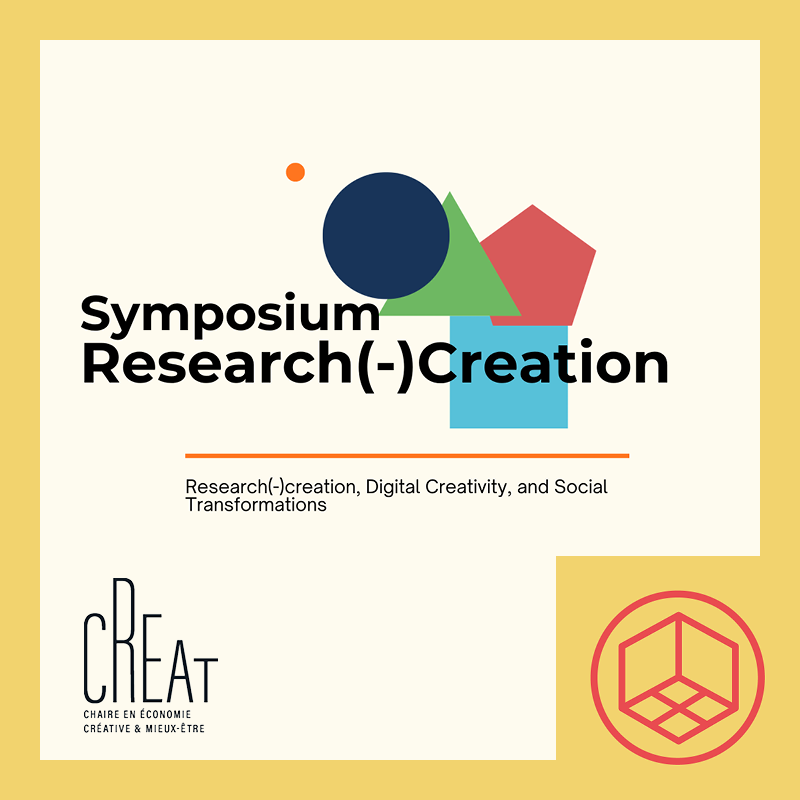
Immersive Conferences—Exploring Knowledge in Fulldome Format


Team

Chantiers coordinator

  • Paloma Leyton, Student member, Université du Québec à Montréal

Chantier AI

Scientific Committee

  • Jean Dubois, Co-investigator member
    Université du Québec à Montréal
  • Fenwick McKelvey, Co-investigator member
    Concordia University

Project Managers

  • Nicole de Brabendere, Collaborator member
    McGill University
  • Ceyda Yolgormez, Student member
    Concordia University

Chantier Cartography

Scientific Committee

  • Yan Breuleux, Co-investigator member
    NAD-Université du Québec à Chicoutimi
  • Louis-Claude Paquin, Co-investigator member
    Université du Québec à Montréal

Project Manager

  • Gabrielle Simard, Student member
    Université du Québec à Montréal

Chantier Ecotechnologies

Scientific Committee

  • Martin Beauregard, Co-investigator member
    Université du Québec en Abitibi-Témiscamingue
  • Natalie Doonan, Collaborator member
    Université de Montréal
  • Jonathan Hope, Collaborator member
    Université du Québec à Montréal
  • Alice Jarry, Co-investigator member
    Concordia University
  • Marie-Christiane Mathieu, Co-investigator member
    Université Laval
  • Gisèle Trudel, Co-investigator member
    Université du Québec à Montréal

Project Manager

  • Patrizio McLelland, Student member and Coordinator of Speculative Life Cluster, Concordia University

Chantier Performa

Scientific Committee

  • Sandeep Bhagwati, Co-investigator member
    Concordia University
  • Nancy Bussières, Co-investigator member
    Université du Québec à Montréal
  • Éric Létourneau, Co-investigator member
    Université du Québec à Montréal
  • Jean-Ambroise Vesac, Co-investigator member
    Université du Québec en Abitibi-Témiscamingue

Project Managers

  • Alexandre Côté, Student Member
    Université du Québec à Montréal
  • Kristian North, Student member
    Concordia University

Chantier XR/Games

Scientific Committee

  • Laureline Chiapello, Co-investigator member
    NAD-Université du Québec à Chicoutimi
  • Martin Lalonde, Collaborator member
    Université du Québec à Montréal
  • Jonathan Lessard, Co-investigator member
    Concordia University
  • Bart Simon, Co-investigator member
    Concordia University

Project Managers

  • Maxime Deslongchamps Gagné, Student member
    NAD-Université du Québec à Chicoutimi
  • Marc-Antoine Jetté Léger, Student member
    Concordia University
  • Alexandra Martin
    Coordinator of Laboratoire 1P1

Past Editions

2024 │ AGENCY·IES
2022 │ EMERGENCE/Y
2020 │ SYMPOIETIC

The Hexagram Network thanks the Fonds de recherche du Québec for its support, as well as its partner institutions: Université du Québec à Montréal, Concordia University, École de technologie supérieure, McGill University, Université de Montréal, Université Laval, the NAD School of Digital Arts, Animation and Design at Université du Québec à Chicoutimi, and Université du Québec en Abitibi‑Témiscamingue.


Cette publication est également disponible en : Français (French)